Is Your Business Built to Handle Its Own Success?
Is Your Business Built to Handle Its Own Success?
When Growth Outpaces Structure And Why Systems Matter More Than Ever
At Ask Rozelle, we regularly work with businesses that appear to be thriving. Clients are coming in, teams are busy, and revenue is moving in the right direction. On the surface, everything looks fine.
Behind the scenes, however, the operation often tells a different story.
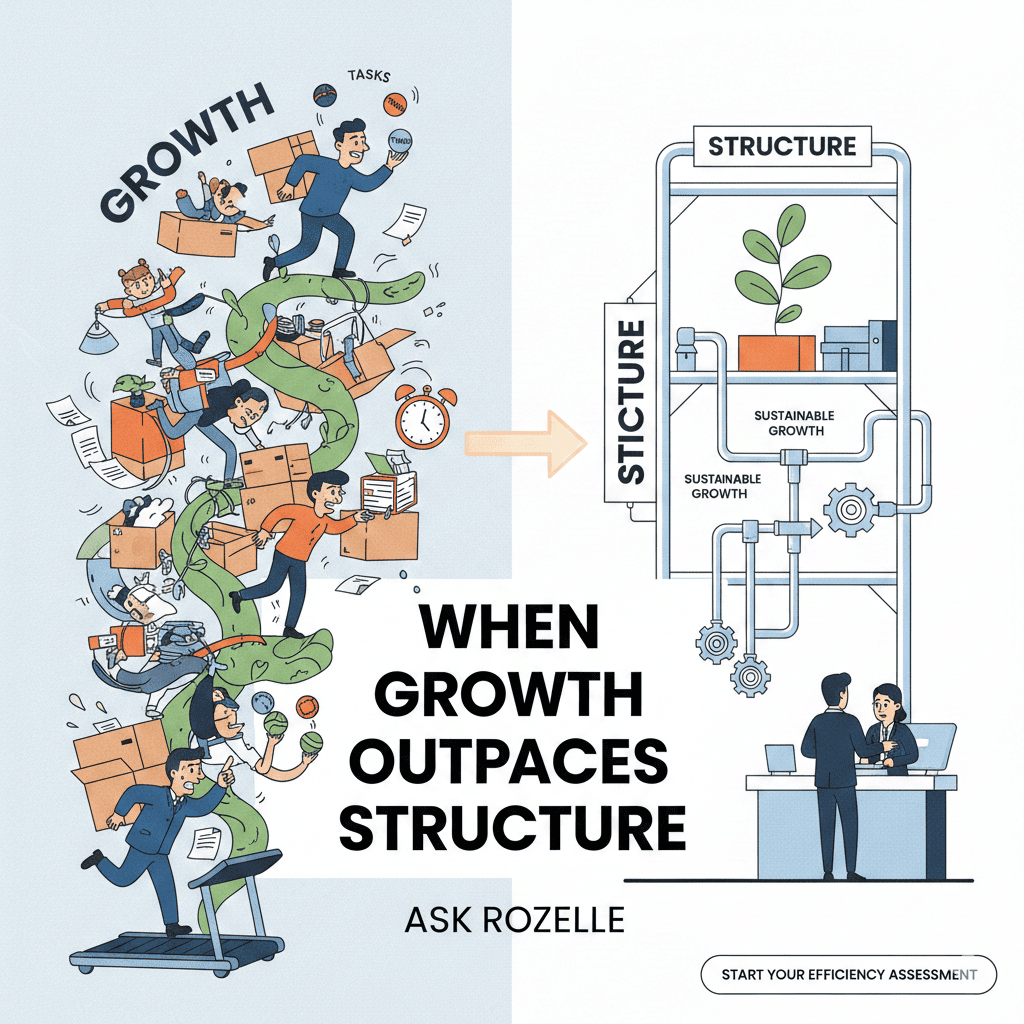
Work relies on memory instead of process. Knowledge lives with individuals rather than within the business. Tasks are completed through effort and improvisation rather than structure. The business is coping, but only because people are carrying the weight.
This is usually when we hear, “We can handle it for now. We’ll sort out systems when things get busier.”
That mindset feels practical, but it is one of the most common and costly mistakes growing businesses make.
When Growth Outpaces Structure And Why Systems Matter More Than Ever
At Ask Rozelle, we regularly work with businesses that appear to be thriving. Clients are coming in, teams are busy, and revenue is moving in the right direction. On the surface, everything looks fine.
Work relies on memory instead of process. Knowledge lives with individuals rather than within the business. Tasks are completed through effort and improvisation rather than structure. The business is coping, but only because people are carrying the weight.
This is usually when we hear, “We can handle it for now. We’ll sort out systems when things get busier.”
That mindset feels practical, but it is one of the most common and costly mistakes growing businesses make.
The Comfort of Coping
When a business is managing to get through the day, it is easy to believe that systems can wait. The workload feels heavy but manageable. Staff are stretching themselves. Problems are solved as they arise.
What often goes unnoticed is that coping is not the same as operating efficiently.
As the business grows, small inefficiencies quietly compound. Workarounds turn into routines. Communication becomes fragmented. The operation becomes increasingly dependent on specific people knowing specific things. Pressure does not disappear. It simply becomes normalised.
This is where growth begins to outpace structure.
Pressure on People Is a Warning Sign
In the absence of clear systems, pressure becomes the default operating model. Deadlines tighten, expectations rise, and staff are expected to “just make it work.” In the short term, many do. In the long term, the cost is high.
Teams begin working in reaction mode. Mistakes increase. Confidence drops. The working environment becomes tense, not because people lack capability, but because the structure does not support them.
Eventually, capable staff leave. Not because the work is too hard, but because the way the work is organised makes it unsustainable. High turnover disrupts momentum, drains leadership time, and stifles growth just when the business needs stability.
When Systems Feel Necessary, It Is Often Too Late
The moment a business realises it urgently needs systems is usually the worst possible time to implement them.
By then, workloads are already heavy. Clients are demanding consistency. There is little room for disruption. Introducing new workflows at this stage creates friction. Productivity dips while teams learn new processes. Old habits clash with new structures. The learning curve temporarily adds strain instead of relieving it.
Rather than supporting growth, delayed systems cause growing pains. Projects slow down. Workflow is disrupted. Clients feel the effects. What should have been a steady improvement becomes a stressful overhaul.
Systems Shift the Weight Off People
Well-designed systems change where the pressure sits.
Instead of relying on individuals to remember, decide, and compensate, the business itself carries the structure. Work becomes repeatable. Expectations are clear. Errors are reduced because the process guides the outcome.
When workflows are efficient, staff can focus on doing their jobs well rather than constantly problem-solving around gaps. Mental load decreases. Confidence improves. Teams function with consistency instead of urgency.
This creates a healthier environment where people can perform optimally without burning out.
Efficiency Creates Space for Sustainable Growth
Efficient operations create stability. Capacity becomes visible. Onboarding new team members becomes simpler. Growth no longer feels risky because the foundation can support it.
Instead of reacting to demand, the business is positioned to respond intentionally. Decisions are proactive rather than rushed. Momentum builds without exhausting the people behind it.
Growth supported by systems feels lighter because it is planned, not forced.
The Ask Rozelle Perspective
At Ask Rozelle, we believe systems are not something to bolt on when things start breaking. They are something to build while the business is still functioning well.
Implementing structure early allows teams to learn and adapt without pressure. Workflows can be refined gradually. Efficiency improves without disruption. When growth arrives, the business is ready for it.
Waiting until systems feel necessary is a gamble. By that point, the cost of change is higher, the learning curve is steeper, and the risk of disruption is real.
If your business feels busy, stretched, or overly dependent on key individuals, an efficiency assessment is the best place to start. It highlights where pressure is building, where workflows are breaking down, and where simple structural changes can unlock capacity and stability.
At Ask Rozelle, our efficiency assessments are designed to give you clarity, not complexity, and a practical path forward that supports sustainable growth.
Final Thought
Growth should not come at the cost of stability, culture, or wellbeing. When a business relies on effort instead of structure, success becomes fragile and exhausting to maintain. Systems are not about slowing things down or adding bureaucracy. They are about creating clarity, consistency, and resilience. The strongest businesses are not the ones working the hardest; they are the ones built to carry their own weight. When structure grows alongside ambition, success becomes sustainable, teams function with confidence, and the business is free to move forward without strain.
